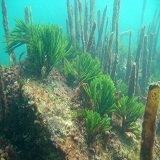
Marine plants comprise of algae, sea grasses, mangroves and sand dune vegetation. Phytoplankton comprises of organisms such as diatoms (bacillariophyta), dinoflagellates (dinophyta), green and yellow-brown flagellates (chlorophyta; prasinophyta; prymnesiophyta, cryptophyta, chrysophyta and rhaphidiophyta) and blue-green algae (cyanophyta). As photosynthetic organisms, this group plays a key role in the productivity of oceans and constitutes the basis of the marine food chain. The characteristic green colour of green algae is mainly due to the presence of chlorophyll a and b in the same proportion like higher plants. The brown colour of brown algae results from the dominance of the xanthophyll pigments and fucoxanthin; this masks the other pigments, chlorophyll a and c, ß-carotenes and other xanthophylls. The red colour of red algae results from the dominance of the pigments phycoerythrin and phycothcyanin; this masks other pigments, chlorophyll a (not chlorophyll b), ß-carotene and a number of unique xanthophylls.
Algae represent a large group of genetically diverse, heterogeneous photosynthetic organisms belonging to different phylogenetic groups and evolutionary lineages, with approximately 30,000 known species. Algae are defined as primitive plants (thallophytes) and lack well- defined structures such as roots, shoots, leaves, seeds and fruits. They can be microscopic or macroscopic, prokaryotic or eukaryotic, unicellular or multicellular, motile or non-motile, attached or free-living, terrestrial or aquatic (marine or freshwater) and aerial or sub-aerial. Algae are a heterogeneous group of plants with a long fossil history. Two major types of algae can be identified: the macroalgae (seaweeds) occupy the littoral zone, which included Chlorophyta (green algae), Phaeophyta (brown algae) and Rhodophyta (red algae), and the micro algae are found in both bentheic and littoral habitats and also throughout the ocean waters as phytoplankton.
Seaweeds are among the first marine organisms chemically analyzed, with more than 3,600 articles published describing 3,300 secondary metabolites from marine plants and algae, and they still remain an almost endless source of new bioactive compounds. Seaweed are excellent sources of vitamins A, B1, B12, C, D & E, riboflavin, niacin, pantothenic acid and folic acid as well as minerals such as Ca, P, Na, and K. All seaweeds offer an extraordinary level of potassium that is very similar to our natural plasma level. Seaweeds are one of the richest sources of iodine, and have been used traditionally as a treatment for thyroid disease and goiter in many countries, as well as for improving metabolism and preventing obesity.